
Ukraintegrity / Updates on Fundamental Reforms #6
Dear Ukraintegrity readers,
Last week, just days before marking its first year in office, the government of Yuliia Svyrydenko was dismissed. President Zelenskyy justified the reshuffle as the beginning of a "new political strategy" for Ukraine. Serhii Koretskyi, the former head of Naftogaz and Ukrnafta, was appointed as the country's new Prime Minister. The government transition took place amid public demonstrations calling for Mykhailo Fedorov to be reappointed as Minister of Defence—a decision that ultimately rests with the President.
The reshuffle also brought changes to Ukraine's European integration team. Taras Kachka, who played a central role in shaping Ukraine's EU accession agenda, was replaced as Deputy Prime Minister for European and Euro-Atlantic Integration by Vsevolod Chentsov, Ukraine's former Permanent Representative to the EU. Yet, as Ukrainian journalists and experts have been saying, "Kachka may be gone, but the Kachka–Kos Plan remains."Whether this government reset will translate into faster and more effective reforms on Ukraine's path to EU membership remains to be seen. For now, independent expert assessments suggest that accelerating the pace of reform is more urgent than ever.
Sincerely,
Inna Nelles on behalf of the German-Ukrainian Bureau (DUB) Team
HIGHLIGHTS
⚡️Ukraine's New Government Takes Office. Prime Minister Serhii Koretskyi has officially begun work with a newly formed Cabinet. While six ministers retained their posts from the previous government, the reshuffle also introduced significant institutional changes. The Ministry of Environmental Protection and Natural Resources has been split into the Ministry of Economy and Ecology and the Ministry of Agrarian Policy and Food. Meanwhile, the former Ministry for Communities and Territories Development (widely known as the Ministry for Restoration) has been reorganized into the Ministry for Communities, Territories and Internally Displaced Persons and the Ministry for Restoration, Infrastructure and Transport. The biggest outstanding questions remain the appointments of the new Minister of Defence and Minister of Foreign Affairs, both of whom are to be nominated by the President. The government formation process is expected to be completed when Parliament reconvenes on 18 August.
🔗BBC News Ukraine overview on Prime Minister Serhii Koretskyi and the new Cabinet
🔗Read about Taras Kachka's expected new role and the future of EU–Ukraine cooperation
⚡️Ukraine Opens Second EU Negotiation Cluster. On July 14th, Ukraine has officially opened Cluster 6: External Relations, becoming the second of six clusters launched in its EU accession negotiations. The cluster covers foreign policy, security and defense cooperation, and trade relations—areas where Ukraine is already closely aligned with EU policies. While the European Commission confirmed that Ukraine has met the technical requirements to open all remaining clusters, political objections from some member states continue to slow the process. The next opportunity to advance negotiations is expected in the autumn.
⚡️Membership Check: Progress Improves, but Reform Pace Remains Insufficient. The second Membership Check assessment by a coalition of leading Ukrainian think tanks shows that in second quarter 2026 Ukraine has made insignificant progress in implementing of the 10 crucial reforms from the so-called Kachka–Kos Plan, with the overall score increasing from 9 to 15 out of 100. Despite this improvement, experts stress that the pace of reforms remains far below what is needed to meet EU benchmarks and keep accession negotiations on track.
🔗Read the report with the most urgent priorities regarding claster Fundamentals
🔗Read European Pravda's analysis of the possible reasons behind Taras Kachka's dismissal as Ukraine's Deputy Prime Minister for European Integration.
⚡️EU accession instruments can advance the country’s public administration reform. A new policy paper Ukraine Gets Ready for Europe by the German Marshall Fund, Ukrainian Center for European Policy, Centre of Policy and Legal Reform and Reanimation Package of Reforms argues that Ukraine’s EU accession will depend not only on adopting EU legislation, but also on building a capable, professional, and resilient public administration. The authors call on the EU to treat public administration reform as a cross-cutting priority throughout the accession process, alongside anti-corruption and rule of law reforms. Strengthening state institutions, they conclude, will be essential for implementing the acquis and ensuring Ukraine’s successful integration into the European Union.
🔗Read the full report
Inside COSAC

DUB at URC 2026
The DUB team participated in the Ukraine Recovery Conference 2026 (URC) in Gdańsk and the accompanying Civil Society Forum, engaging with policymakers, civil society leaders, international organizations, and businesses. This year's conference underscored a growing consensus that Ukraine's recovery cannot be separated from its security, democratic reforms, and EU accession.
Bringing Ukraine's Reform Progress to Brussels
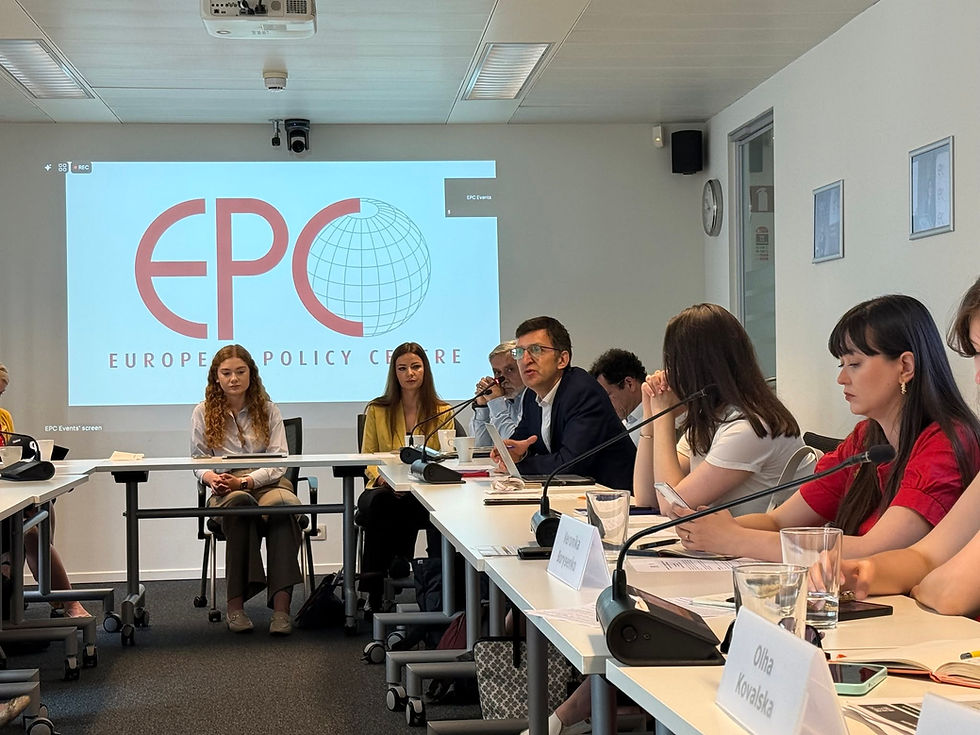
As part of the COSAC Reforms Initiative, DUB accompanied a delegation of Ukrainian think tanks to Brussels to present the latest Membership Check findings to EU institutions. Together with the European Policy Centre (EPC), DUB also co-hosted an expert discussion on Ukraine's reform progress, highlighting that sustained progress on rule-of-law reforms is essential for advancing the country's EU accession.


Comments